Bamboo Mites
Mites on your otherwise healthy bamboo plants are only an aesthetic problem. However, for all their numbers and the cosmetic damage, mites do not diminish the vigor of an established plant.
Most people do not recognize mite damage, even close-up. To the inexperienced eye, it can look like a natural variegation of the leaf.
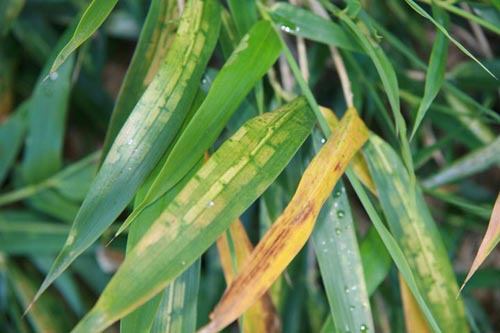
Typical mite leaf damage on the face of the leaves.
Mites live and feed on the under-sides of the leaves. You will first observe mite damage as patterns of pale cream-coloration on the upper-sides of leaves. These patterns are called 'tessilations'.
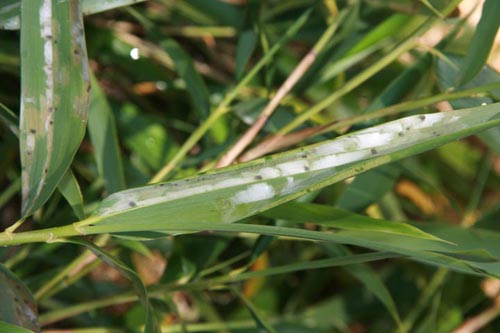
Typical mite white tent material underside of leaves.
'Tessilations' are the result of 'tent' colonies woven next to each other on the under-sides of the leaves. They are usually a millimeter or two rectangular, and when a leaf is turned over, you will see the little snow-white, tightly woven 'tents'. These tents are the protective coverings for the colonies of mites, and they are very tough; they are difficult to rub off with finger pressure. The insects construct their tents in the recessed area along the ridges of the leaf.
Mites will spend most of their life-cycle under these protective coverings, where they suck away at the chlorophyll and procreate. Mites will move away from their protective covering to defecate and when it's time to colonize. Temperatures determine the rate of procreation and colony expansion. In Pacific Northwest winter conditions, the mite populations will plummet, but it seems there are always some that survive to the next season.
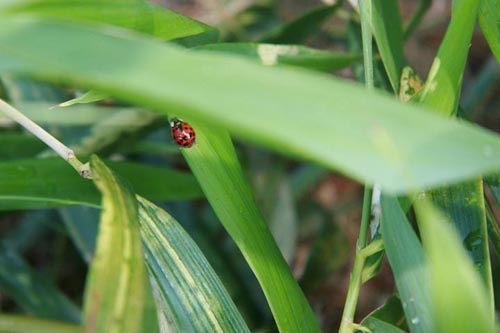
Lady bugs "mite" help!
There are very small birds in our nursery groves that maintain the mite populations.
Seattle Bamboo
Seattle Bamboo is licensed by the State of Washington to solve bamboo problems, bonded to assure the work gets done as agreed, and fully insured to work on your property. Our state license number is SEATTB*913ML
Seattle Bamboo Contact Information
Email us at bruce@seattlebamboo.com
We answer bamboo questions with honest answers, not answers that promote profit.
Or call us at 206.724.1977